

Making workshops more accessible for teens
Adapting to accommodate neurodivergence amongst young people


In last week’s post, I wrote about how ADHD has impacted my poetry career. This week, I’m writing about making poetry workshops more accessible for teenagers, with neurodivergence increasingly prevalent amongst youngsters.
As with any poetry workshop, the smaller the group, the easier it is to meet everybody’s needs on an individual level. Delivering a group of 15 or fewer is the dream. But I’ve written this with a class-sized group in mind (roughly 30 pupils) and have tried to be realistic about what schools can facilitate.
I’m very fortunate to be delivering on a Barnsley Young Producers project at the moment. Barnsley Libraries is funding me to work with a smaller group at Penistone Grammar School, and as part of the application, I was asked to explain how I’d make the sessions accessible. Some of the young people were on the decision panel, and so it meant a lot to me that my application was selected.
We’re now two sessions in, so I thought it’d be a good idea to speak to you about my thought process and provide insight into what I thought would work and what actually works. Also, to be clear, I’m basing this on several years of experience in delivering accessibility-focused workshops: not just the BYP project specifically.
Making workshops more accessible for teens
I haven’t had any formal training or guidance in this field and am certainly not claiming to be an expert. As usual, I’m just sharing my experiences as openly and honestly as I can, to hopefully provide some guidance for your own practice.
Almost all of my experience is in state schools, with a good level of experience in Alternative Provisions such as PRUs and SEMH schools, as well as out-of-school provision and homeschooling.
1. Minimise pen to paper in silence
Having the pupils chat quietly with their immediate neighbours is your ideal scenario, but it often leads to too much distraction and not enough writing. That said, having them write in absolute silence (exam-style) should be avoided. It can work on occasion, either to regulate a rowdy room or for shorter, time-trial prompts (up to three minutes in length), but generally, I find it creates a slightly tense and uneasy atmosphere. And if I find it uncomfortable as the facilitator, I’m sure they find it uncomfortable as the participants.
• Chillhop playlists are the absolute don
I use them as often as possible, and it always contributes to a more relaxed, creative environment. I mentioned Chillhop in my recent ‘Poetry for Wellbeing’ post and have incorporated their use in a wider range of sessions over recent years.
You can find Chillhop on YouTube, Spotify, and Apple Music. Chances are, YouTube is your most likely option, although it can depend on whether you’re working in a “Google school” or not. It’s worth checking with the teacher in advance, and it’s always best to play Chillhop through one of their devices (there’s almost always a laptop in the classroom) instead of from your phone. Some schools don’t allow you to have your phone out, and even so, it should always be avoided — it doesn’t look good, and there are potential safeguarding issues.
• Another approach is to crowd-source group poems
Asking them to contribute verbally rather than write things down on paper is a fantastic way to engage pupils, particularly those who lack confidence in committing things to writing. Pupils who are dyslexic or have ADHD often respond to this approach much better.
There are a few approaches here: either you can act as the scribe, gathering lines and ideas on the whiteboard/flipchart or even in an A3 pad. Another approach is to lead a group spoken response, snaking around the room like a domino, with each pupil taking it in turn to respond to a basic prompt.
I’ll leave two very specific group spoken responses for paid subscribers at the bottom.
Finally, you can set them off on a task and then continue to drip-feed prompts as you guide them through it. Think of it as being in the style of a hypnotist: gentle, non-intrusive prompts to add new layers, make new suggestions, and walk them through the prompt. I once saw Salena Godden take this approach in a workshop, and it worked brilliantly.

2. Vary what they’re writing on
This is budget-dependent, of course, but if I’m working with a smaller group (15 or fewer), I stock up on revision cards, Post-It notes, etc., plus a range of pens and pencils.
If you’re based in the UK, these supplies are extremely cheap from The Works. The introduction of coloured pens and pencils inevitably increases the amount of doodling, but any form of creativity is good. It’s often a form of soothing and regulation, and, so long as you encourage as much writing as possible, it’s all good.
• Experiment with types of paper
I tend to find that using plain paper rather than ruled is great for some kids but not others. I always loved the idea of embracing the “freedom” of plain paper, but some pupils — particularly those who are neurodivergent — need the lines. It brings comfort and structure, and I’ve often seen pupils using a ruler to draw their own lines on a sheet of plain paper.
You can also mix up the sheet size (A5, A6, etc.) and the colours. Writing on soft pastel shades is often better for neurodivergent pupils.
3. Model your prompts and provide clear visual instructions
I’ve always avoided using screens as much as possible in classrooms. There’s inevitably a generational stubbornness behind this, and it’s good to keep any screen time to a minimum.
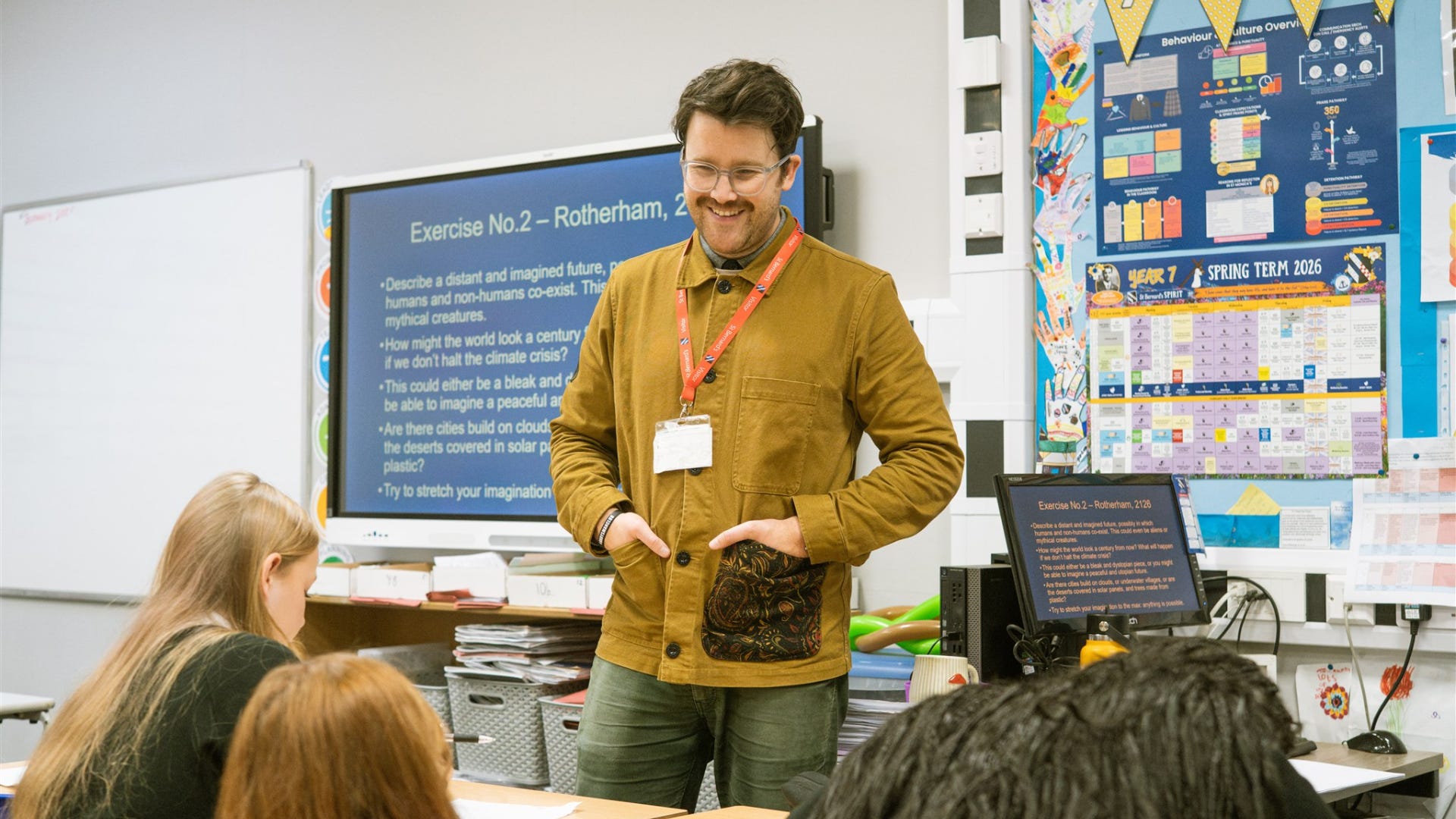
However, over the last few years, I’ve found it’s impossible to deliver a workshop without clear visual prompts throughout. This could be in the form of a basic presentation (as in the picture above), but most of the time, I make full use of a whiteboard or flipchart.
I used to only write key headings, with the majority of the instructions delivered verbally. Nowadays, that doesn’t cut it: you need to have clear, visible instructions and, where possible, model what you’re doing. Demonstrate an example, talk them through the process, and explain any structure.
In an ideal world, you want to leave as much as possible to the pupils’ creativity, imagination, and initiative. But in our reel-obsessed world, it’s often impossible to rely on this. Always bear this in mind when facilitating: explain, demonstrate, explain again, and provide as much visible guidance as you can.
4. Dependent on group size, provide fidget toys
Chances are, pupils will have their own fidget toys in their bags. But if I’m working with a smaller group, I bring my own selection. Again, these are very cheap from places such as The Works or Smyths. You can usually buy sensory multipacks for less than £10.
Make it clear that sensory or fidget toys are welcome in the session. Again, as with the doodling risk, it’s a fine line between allowing these toys for soothing and regulation, and encouraging the session to descend into distraction.
For me, it’s a case of normalising these fidget toys and creating a ‘safe space’ to use them in support of creative activities. I often walk around the room with my own fidget popper, and this visibility often puts pupils at ease. I disclose my ADHD diagnosis and reassure them that I want them to feel relaxed and comfortable whilst also being productive.

5. Break your sessions into smaller chunks and communicate timings
Breaking sessions into smaller chunks has always been my approach since I began over 10 years ago. However, this is becoming increasingly important, and there are two other factors to consider.
Firstly, be sure to vary the chunks. Don’t have more than two straight-up writing chunks back-to-back, for example: break it up with discussion, performance, spoken responses, and so on. Ensure a nice variety and consider how your session will ebb and flow: attention spans are short, and too much intense writing can quickly cause classroom fatigue and a lack of focus, which is hard to regain.
Secondly, communicate your timings clearly. This is very useful for putting autistic pupils at ease, for example. This works for individual chunks and the whole session: for example, set a prompt, and then say, “We’re going to write for 7 minutes.” Where possible, a visual timer on a smartboard can be useful in this regard.
When discussing the whole session, I’ll usually give a brief overview of the plan (writing, then chatting, then writing, etc.) and let them know the timings (if breaktimes are different from their usual timetable, for instance).
6. Recognise when it’s overstimulating
Finally, try to gauge when the room might be becoming too overstimulating for some pupils. It’s wonderful when they’re excited about an idea or a performance, but you need to ensure the room isn’t too loud for too long.
Have a few calming, “regulation” exercises up your sleeve to bring it back down again. This could be quickfire writing tasks, independent reading time, or even a case of you sharing a few softer, gentler poems in a calm and soothing style.
Your teacher can often guide you with this, but it’s very much something to be aware of. I used to only focus on disruptive behaviour, but even positive and energetic responses need to be managed. Must as you don’t want to extinguish any positivity, this can sometimes feel overwhelming and stressful for neurodivergent pupils, and it’s good to be sensitive to this.

To summarise
Your school will inform you if any pupils have particular needs you should be aware of. They should have their own internal support in place, and ultimately, it’s their responsibility to ensure every pupil’s needs are being met.
However, as a poetry facilitator, I feel it’s increasingly important to be sensitive to additional needs and to go out of your way to make your visits as inclusive and accessible as possible. Poetry is, by nature, a very sensitive art form, and I feel we have a responsibility to make everybody feel as included as possible.
Schools will also have their own internal safeguarding procedure, and it’s usually very clear who the designated safeguarding leads are. Be sensitive and discreet with potential safeguarding issues, and speak to staff if you have any concerns.
Again, to reiterate, I haven’t completed any formal training, and this post is not intended to be official guidance. I’m just a poet trying to speak from my experience to help others.
I hope this post has been useful. Please subscribe to The Day Job if you’ve yet to do so, and consider becoming a paid subscriber for £5 per month! Thank you.
Spoken group exercises for paid subscribers
As promised, here are two of my favourite spoken group exercises, which I’ll reserve exclusively for paid subscribers.
